Scope 3 Emissions Data Quality Calculator
How accurate is your Scope 3 emissions reporting? This calculator estimates potential errors based on your data quality and key categories. The Greenhouse Gas Protocol shows data quality can create 25-50% errors in purchased goods emissions alone.
Your Data Quality
Scope 3 Categories
Select the categories most relevant to your business. The most impactful categories (purchased goods, downstream use) typically contribute 80% of total Scope 3 emissions.
Most companies don’t realize their biggest climate impact isn’t in their factories or offices-it’s hidden in their supply chains. Scope 3 emissions make up about 75% of the average company’s total carbon footprint. For some, like Apple, it’s as high as 98%. Yet, getting accurate data from suppliers remains one of the toughest challenges in corporate sustainability. You can’t manage what you can’t measure, and right now, most companies are measuring with guesswork.
What Exactly Are Scope 3 Emissions?
Scope 3 emissions are all the indirect greenhouse gas emissions that happen outside your direct control but are tied to your business. Think of them as the hidden footprint of everything you buy, sell, and use. The Greenhouse Gas Protocol breaks them into 15 categories, from the raw materials you purchase to how customers use your products and what happens when they throw them away.
Category 1-purchased goods and services-is usually the biggest. If you sell smartphones, the emissions from mining rare metals, making circuit boards, and shipping components add up fast. Category 11-use of sold products-is equally critical. A carmaker’s emissions aren’t just from building the car; they’re from millions of miles driven by customers. And if you sell coffee, the emissions from farming, roasting, and brewing matter more than your office lights.
These aren’t theoretical numbers. The EU’s Corporate Sustainability Reporting Directive (CSRD) now requires around 50,000 companies to report Scope 3 emissions by 2028. The U.S. SEC is pushing public companies to do the same. Ignoring this isn’t an option anymore. But collecting the data? That’s where things fall apart.
Why Supplier Data Is Broken
Only 18% of Fortune 500 companies collect primary data-directly from suppliers-for more than half of their Scope 3 emissions. The rest? They use industry averages, spreadsheets, and outdated models. This isn’t just sloppy. It’s misleading.
Take electronics manufacturing. Secondary data can underestimate emissions by 25% to 50%. Why? Because one factory in Vietnam might use coal-powered electricity, while another in Germany runs on wind. Using an average hides the truth. MIT found that emissions from purchased goods have a ±40% margin of error. That means your carbon report could be off by nearly half.
And getting suppliers to respond? It’s a nightmare. On average, only 35% to 45% of suppliers reply to emissions requests. One procurement manager on Reddit said she spends over 200 hours a year chasing 15 key suppliers-and still only gets complete data from eight. Smaller suppliers, who make up most of the chain, often can’t afford the time or tools to report. A 2022 BCG survey found 78% of SMEs lack the resources. That’s not laziness. It’s systemic failure.
Supplier Engagement: What Actually Works
Just asking nicely doesn’t work. You need structure. The most successful companies treat supplier engagement like a business process-not a charity request.
BMW embeds environmental questionnaires into its procurement contracts. Result? 65% supplier response rate. Unilever runs a Supplier Sustainability Academy, training over 2,300 suppliers across 65 countries. That’s not just collecting data-it’s building capability. And it’s paid off: they’ve cut 14.3 million metric tons of CO2e since 2019.
Another proven tactic? Tie emissions data to purchasing decisions. If a supplier can’t or won’t report, you reduce their orders. Companies committed to Science Based Targets (SBTi) use this approach 57% of the time. It’s not punitive-it’s practical. Suppliers learn quickly when their bottom line is on the line.
But here’s the catch: not all suppliers are equal. Automotive and tech firms get better responses than food and beverage companies. Why? Because supply chains in food are fragmented, with thousands of small farms and processors. No single tool works for everyone. You need to segment your suppliers and tailor your approach.
Data Integrity: The Real Bottleneck
Even when you get data, it’s often inconsistent. A 2023 study by Professor Yannick Magnin found 68% of corporate Scope 3 disclosures have methodological flaws. One company might use kilowatt-hours, another uses energy cost. One calculates transportation by weight, another by distance. You can’t compare apples to oranges if you don’t know what fruit you’re holding.
The solution? Standardization. The International Sustainability Standards Board’s S2 standard, effective since January 2024, is trying to fix this. It demands consistent reporting across 140+ countries. But adoption is slow. Only 22% of companies feel confident they can comply by 2025.
Some are cutting through the noise with tech. Salesforce’s Net Zero Cloud cuts data processing time by 65%. Maersk and Microsoft are using blockchain to track emissions across shipping routes, reducing verification time by 43%. Normative and Persefoni process millions of supplier invoices monthly, turning raw data into actionable insights.
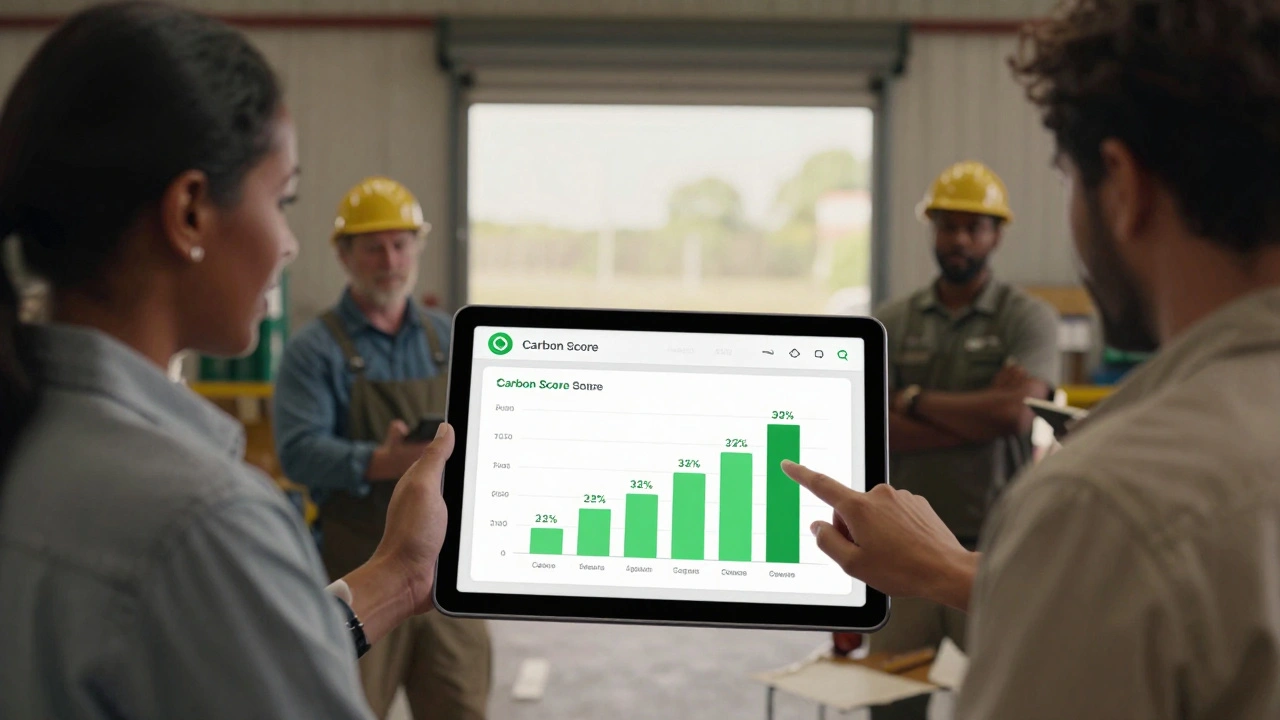
But tech alone won’t fix human problems. The real breakthrough came when Michael Rodriguez, a sustainability director at a Fortune 500 manufacturer, embedded carbon metrics into SAP Ariba-their procurement system. Suppliers saw carbon scores right alongside price and delivery time. Response rates jumped from 32% to 79% in 18 months. When emissions data becomes part of the buying process, not an afterthought, people pay attention.
What You Need to Start
Don’t try to boil the ocean. Start with your biggest impact areas. The EPA’s Scope 3 Evaluator tool helps identify which of the 15 categories matter most. Most companies find that purchased goods, business travel, and downstream use of products account for 80% of emissions.
Then follow a simple five-step process:
- Assess materiality-Which categories are most significant? (Takes 4-8 weeks.)
- Set boundaries-What suppliers count? What products?
- Collect data-Use a mix of primary (direct from suppliers) and secondary (industry averages) sources.
- Calculate-Use the hybrid method: combine supplier-specific data with averages where needed.
- Verify-Get third-party validation. It’s not optional anymore.
Microsoft reports 92% coverage of its Scope 3 emissions. How? They spent 18 months building relationships before they even started measuring. Nestlé’s Supplier CO2 Tool gave 1,200+ suppliers ready-made templates and calculators. Data completeness jumped 47%.
You don’t need a $1 million software license to start. You need a plan, a priority list, and the discipline to follow up.

The Hidden Cost of Inaction
Ignoring Scope 3 isn’t just risky-it’s expensive. SMEs spend $15,000 to $50,000 a year just trying to meet corporate reporting demands. That’s a huge burden for small suppliers, which is why many drop out. And when they do, you lose visibility into 32% of your total emissions.
Investing in supplier support pays off. Unilever’s training program didn’t just improve data-it reduced emissions. Companies that treat suppliers as partners, not vendors, see faster progress. Those that treat them as compliance checkboxes get poor data and broken relationships.
And let’s be honest: if your Scope 3 report looks like a guess, investors, regulators, and customers will notice. The Science Based Targets initiative says only 35% of companies will hit valid targets by 2030 unless data collection improves. That’s not a prediction-it’s a warning.
Final Thought: It’s Not About Perfection
You won’t get 100% accurate data tomorrow. But you can get better. Start with your top three emission categories. Pick 10 key suppliers. Give them simple tools. Track progress. Celebrate small wins. The goal isn’t to have a perfect report. It’s to build a system that gets more accurate every year.
Scope 3 emissions aren’t going away. The pressure is only growing. The companies that win aren’t the ones with the fanciest software. They’re the ones who treat their supply chain like the most important part of their climate strategy-because it is.
What are the 15 categories of Scope 3 emissions?
The Greenhouse Gas Protocol defines 15 categories: purchased goods and services, capital goods, fuel and energy-related activities, upstream transportation and distribution, waste generated in operations, business travel, employee commuting, upstream leased assets, downstream transportation and distribution, processing of sold products, use of sold products, end-of-life treatment of sold products, downstream leased assets, franchises, and investments. These cover everything from your suppliers to how customers use your products.
Why is supplier data so hard to collect?
Most suppliers, especially small ones, lack the time, tools, or expertise to measure emissions. They’re not sustainability teams-they’re manufacturers, farmers, or logistics firms. Asking them to fill out complex surveys without support leads to low response rates (35-45%). Many also fear disclosing data could make them less competitive or expose cost structures.
Can I use industry averages instead of supplier data?
You can, but it’s risky. Industry averages can underestimate emissions by 25-50% for categories like electronics or food production. The GHG Protocol allows secondary data as a fallback, but regulators and investors increasingly expect primary data for high-impact categories. Using averages only is no longer seen as credible.
What’s the cheapest way to start tracking Scope 3 emissions?
Start with the EPA’s free Scope 3 Evaluator tool. Focus on your top three emission categories. Pick 5-10 key suppliers and send them a simple template with clear instructions. Use Excel or Google Sheets to track responses. You don’t need expensive software to begin-just consistency and follow-up.
How do large companies like Apple or Microsoft manage Scope 3?
They invest heavily in supplier engagement. Apple works directly with its top suppliers to redesign manufacturing processes. Microsoft spends 12-18 months building relationships before collecting data. Both embed carbon metrics into procurement systems and use third-party verification. Their success isn’t from technology-it’s from treating suppliers as long-term partners, not vendors.
Is Scope 3 reporting mandatory?
For public companies in the U.S., the SEC requires it if emissions are material-likely starting in 2024. In the EU, the CSRD requires it for about 50,000 companies by 2028. Even if not yet required, investors, customers, and rating agencies are demanding it. Voluntary reporting by S&P 500 companies has jumped from 39% in 2020 to 68% in 2023.
What skills do I need to manage Scope 3 emissions?
You need carbon accounting knowledge, supplier relationship skills, and basic data analysis. Most companies assign 3-5 full-time staff to this work. Salaries for carbon accountants range from $95,000 to $140,000. But more than technical skills, you need persistence. Getting suppliers to respond is 80% communication and follow-up, 20% software.
Can small companies afford to report Scope 3?
Yes, but not alone. Smaller suppliers can join industry groups or use shared platforms like the Carbon Trust’s SME toolkit. The real cost isn’t the reporting-it’s the pressure from big buyers. If you’re a supplier to a major company, you’ll be asked to report anyway. Starting early, even with basic data, builds trust and avoids last-minute panic.